Safety Integrity Levels (SIL): What They Are and How to Calculate Them

August 26, 2025

When a system’s failure could cause injury, environmental damage, or significant operational disruption, its safety functions need to meet defined reliability targets. Safety Integrity Levels (SIL) are the way engineers quantify and design for that reliability.

Rooted in the IEC 61508 standard for electrical, electronic, and programmable electronic safety systems, SIL ratings guide everything from architecture decisions to verification methods. They are as relevant to a medical infusion pump as they are to an industrial robot arm or a power grid control system. Understanding SIL ensures that safety-critical designs are backed by measurable, standards-based assurance.

What Is a Safety Integrity Level?

A Safety Integrity Level (SIL) is a numeric measure of the required risk reduction for a safety function in a system. Defined in IEC 61508 (the international standard for functional safety of E/E/PE systems), SIL ensures that critical safety functions perform reliably when needed, particularly under hazardous conditions.

SIL applies to both hardware reliability and the integrity of the design process across the product lifecycle, encompassing design, implementation, and maintenance.

SIL levels are determined by:

  1. PFDavg (Probability of Failure on Demand) for low-demand systems.
  2. PFH (Probability of Dangerous Failure per Hour) for high- or continuous-demand systems.

Knowing the SIL level provides engineers with a target for design integrity, testing depth, and redundancy requirements.

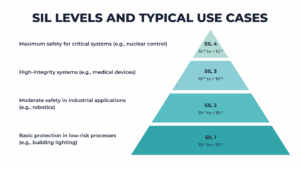
Description:
A 4-layered pyramid where each layer represents a SIL level, going from SIL 1 at the base to SIL 4 at the top. Each layer should include:

  1. SIL number
  2. PFDavg range
  3. Example applications (from the table below)
SIL LevelPFDavg RangeTypical Use Case
SIL 110⁻² to < 10⁻¹Basic risk reduction for low-risk processes
SIL 210⁻³ to < 10⁻²Moderate safety, common in industrial applications
SIL 310⁻⁴ to < 10⁻³High-integrity systems where critical safety is required
SIL 410⁻⁵ to < 10⁻⁴Extremely high safety applications, such as nuclear or aerospace

How to Calculate SIL

Understanding the theory is one thing, but applying SIL in practice starts with a structured approach to risk. Each stage of the calculation process builds on the previous one, ensuring nothing is overlooked.

Step 1: Identify Hazards
Use techniques such as HAZOP (Hazard and Operability Study) or FMEA (Failure Modes and Effects Analysis) to identify potential safety-critical events. Focus on scenarios where system failure could cause harm, environmental damage, or process disruption. 

For instance, on a packaging line, you might identify entrapment hazards near moving parts.

Step 2: Assess Risk
Quantify the hazard’s severity, frequency of exposure, and the likelihood of avoiding harm. Tools include Risk Graphs, Layer of Protection Analysis (LOPA), and Fault Tree Analysis (FTA).

For example, an operator facing a weekly risk of serious injury with limited avoidance options would be in a high-risk situation.

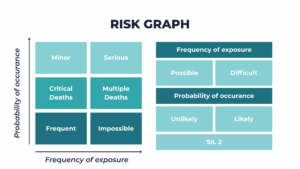
Description:
A 4-axis labeled graph or table where the axes are:

  • Severity (C) → e.g., Minor → Serious Injury → Multiple Deaths
  • Frequency of Exposure (F) → e.g., Rare → Occasional → Frequent
  • Avoidability (P) → e.g., Possible → Difficult → Impossible
  • Probability of Occurrence (W) → e.g., Unlikely → Likely → Certain

Output: Map to SIL level.
Example case result: SIL 2

Step 3: Define Tolerable Risk
Set risk thresholds based on internal safety policies or industry-specific standards (such as ISO 13849 for machinery). Suppose your analysis shows that the system needs to reduce risk by a factor of 1,000—this corresponds to a SIL 2 requirement.

Step 4: Assign SIL with a Risk Graph
Map severity, frequency, avoidability, and likelihood into a Risk Graph to confirm the required SIL. In our packaging example, this might again yield SIL 2.

Step 5: Verify Design Compliance
Once the target SIL is known, the safety system must be validated to meet it. This involves analyzing hardware fault tolerance, diagnostic coverage, and failure rates.

Description:
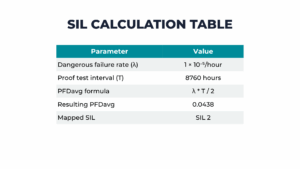
A sample table illustrating how PFDavg is calculated and mapped to SIL level:

ParameterValue
Dangerous failure rate (λ)1 × 10⁻⁵/hour
Proof test interval (T)8760 hours
PFDavg formulaλ * T / 2
Resulting PFDavg0.0438
Mapped SILSIL 2


Formula shown:

PFDavg=λ×T2=1×10−5×87602=0.0438⇒SIL 2\text{PFD}_{avg} = \frac{λ \times T}{2} = \frac{1 × 10⁻⁵ × 8760}{2} = 0.0438 \Rightarrow \text{SIL 2}PFDavg​=2λ×T​=21×10−5×8760​=0.0438⇒SIL 2

5. Verify Design Compliance

After defining the target SIL, confirm that the design meets it by checking:

  • Hardware fault tolerance
  • Diagnostic coverage
  • Failure rates

Example Calculation
If:

  • Dangerous failure rate (λ) = 1 × 10⁻⁵/hour
  • Proof test interval (T) = 8,760 hours

PFDavg = (λ × T) ÷ 2 = (1 × 10⁻⁵ × 8,760) ÷ 2 = 0.0438 → SIL 2

SIL 1 vs. SIL 4: What’s the Difference?

Moving from SIL 1 to SIL 4 increases the demands on architecture, diagnostics, and verification.

For example:

  1. SIL 1 systems (e.g. LED lighting, HVAC) require basic diagnostics and simple failure detection.
  2. SIL 2 applications (e.g. food processing, robotics) introduce redundancy and require diagnostic feedback.
  3. SIL 3 designs (e.g. medical devices, energy relays) use dual-channel architectures with advanced diagnostics and protocols.
  4. SIL 4 systems (e.g. nuclear plant control, aerospace) demand triple redundancy and fail-operational capabilities, with rigorous validation and verification.


These differences affect not only safety performance but also cost, development time, and certification complexity.

How SIL Is Applied Across Industries

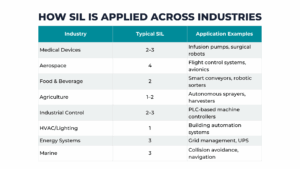
SIL requirements vary by sector, but the principle is the same: match the safety function’s integrity to the potential risk.

Description:
A matrix showing industries on one axis and SIL levels on the other, with typical application examples in each cell.

IndustryTypical SILExample Application
Medical DevicesSIL 2–3Infusion pumps, surgical robots
AerospaceSIL 4Flight control systems, avionics
Food & BeverageSIL 2Smart conveyors, robotic sorters
AgricultureSIL 1–2Autonomous sprayers, harvesters
Industrial ControlsSIL 2–3PLC-based machine controllers
HVAC/LightingSIL 1Building automation systems
Energy SystemsSIL 3Grid management, UPS
MarineSIL 3Collision avoidance, navigation

Ensuring Your Product Meets the Right SIL

Every product needs to answer one key question: is it safe enough for real-world use? Achieving the right Safety Integrity Level (SIL) requires detailed risk assessments, thorough design validation, and adherence to international safety standards—tasks that can quickly become complex and costly without the right support.

At EKTOS Development, we make the process manageable. From concept to certification, our team helps you:

  • Determine the appropriate SIL level for your product.
  • Design hardware and software systems that meet functional safety requirements.
  • Provide guidance on testing, validation, and documentation.

Whether your goal is compliance with IEC 61508, ISO 26262, EN 60601, ISO 13849, or EN 62304, our experience ensures that your development process is structured, efficient, and compliant.

About the Author 

Vadym Dovhopolyi is a Technical Solution Architect at EKTOS and a seasoned systems engineer with deep expertise in functional and technical safety. 

He architects and delivers complex, safety-critical electronics across hardware and software domains, helping OEMs develop certifiable, high-performance systems. 

Known for guiding teams to exceed engineering and compliance goals, he brings a practical, standards-driven approach to innovation.
Scroll to Top
This site is registered on wpml.org as a development site. Switch to a production site key to remove this banner.