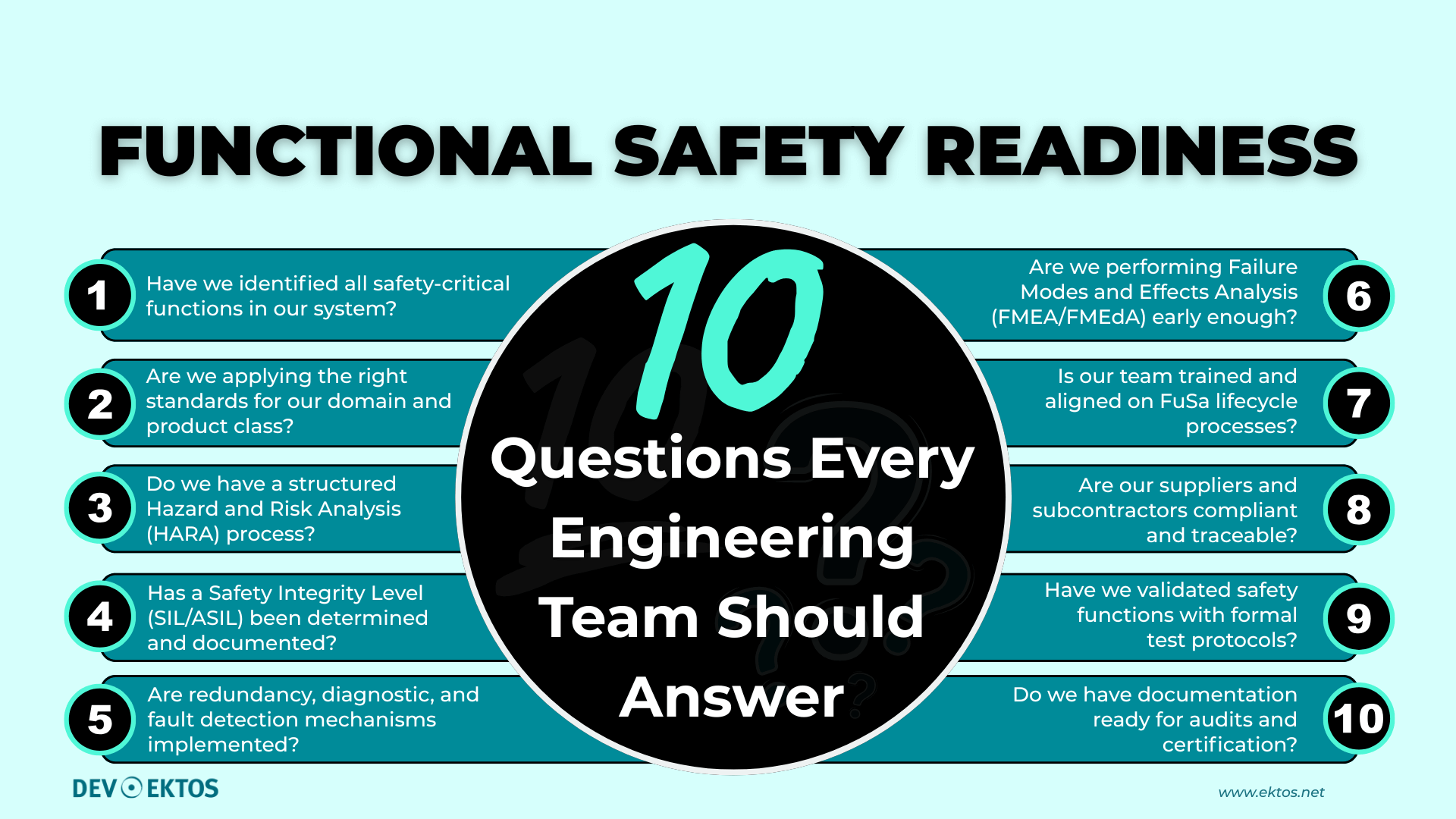
1. Have You Identified All Safety-Critical Functions in Your System?
Identifying safety-critical functions is the first step to building a secure system. These functions, when they fail, can lead to hazardous situations. Your team must understand how these functions interact and where potential risks exist.
The takeaway: Ensure the team has mapped out the system’s critical functions. Tools like System-Theoretic Process Analysis (STPA) or Preliminary Hazard Analysis (PHA) help identify these risks early in the design phase.
2. Are You Using the Correct Standards for Your Industry?
Different industries have their own standards for functional safety. Misaligning your system with the wrong standards undermines both technical integrity and certification readiness. That’s why it’s crucial to match your system’s needs with the appropriate safety framework, for example:
- Automotive: ISO 26262
- Industrial: IEC 61508, ISO 13849
- Medical: IEC 60601, EN 62304
- Machinery: ISO 13849, IEC 62061
Important tip: Align your V-model development lifecycle, verification strategy, and documentation with the chosen standards from project inception.
3. Do You Have a Robust Hazard and Risk Analysis (HARA) Process?
Performing a comprehensive Hazard and Risk Analysis (HARA) ensures all potential risks are identified and mitigated. This process quantifies risk using the Severity, Exposure, and Controllability (SEC) criteria, helping prioritize safety measures.
Key advice: Implement a formal risk analysis process early. Utilize tools that automate specific aspects of HARA to enhance the process’s efficiency and traceability.
4. Have You Defined the Safety Integrity Level (SIL/ASIL) for Each Function?
Assigning a Safety Integrity Level (SIL) or Automotive Safety Integrity Level (ASIL) is crucial in determining the safety mechanisms your system requires. It influences which design patterns, redundancy mechanisms, and verification rigor must be applied. The higher the risk level, the more rigorous the safety mechanisms are needed.
For example, a SIL 3 or ASIL D system requires fail-operational or fail-silent architectures, and extensive redundancy to ensure safety under extreme conditions. While lower ASIL/SIL levels may allow single-point tolerance with diagnostic checks.
The bottom line: Make sure each function’s SIL/ASIL assignment is documented, with clear reasoning behind each decision.
5. Have You Incorporated Redundancy and Fault Detection?
No matter how well you design your system, things can go wrong. That’s why, no safety architecture is complete without proven fault detection and isolation (FDI).
This includes:
- Watchdog timers to detect software lockups
- End-to-end communication CRC checks
- Sensor plausibility diagnostics
- Redundant channels for critical functions (e.g., dual independent sensors)
- Graceful degradation strategies for continued safe operation after fault detection
These measures must be aligned to the Diagnostic Coverage (DC) levels required by the assigned ASIL/SIL.
6. Are You Conducting Failure Modes and Effects Analysis (FMEA/FMEDA)?
FMEA and FMEDA are essential for identifying potential failure points in your system. They help you determine the consequences of failure and the necessary safety measures to mitigate those risks.
How to approach this:
- Conduct FMEA during the early design phase.
- Use FMEDA to include diagnostic analysis, ensuring all failure modes are covered.
The earlier you tackle FMEA/FMEDA, the more control you’ll have over potential failure risks, preventing costly changes later in the development process.
7. Is Your Team Aligned on FuSa lifecycle processes?
FuSa is a process-driven discipline. It’s a process that requires the entire team’s buy-in. If only a few people understand the processes, it can lead to gaps in the safety system. Everyone on your team needs to understand the functional safety lifecycle.
What’s the best approach? It’s critical to train your whole team—not just engineers but testers, project managers, and everyone in between. This ensures that everyone understands their role and contributes to the safety efforts.
The team-wide training topics should include:
- The full V-model safety lifecycle
- How to identify Safety-Related Elements (SREs)
- How to apply safety patterns and coding guidelines (e.g., MISRA C)
- Verification and validation roles and activities
- Traceability and documentation requirements for audits
The more aligned your team is, the easier it will be to meet safety milestones and pass certification.
8. Are Your Suppliers Meeting Functional Safety Standards?
Your system can only be as safe as the parts and components it’s built with. If your suppliers aren’t compliant with the same functional safety standards you follow, your system’s safety could be compromised.
What can you do?
- Audit your suppliers to ensure they’re following your safety requirements.
- Use Supplier Safety Requirements Specifications (SRS) to set expectations.
- Track supplier performance and ensure compliance with safety standards.
- Independently verify the supplier FMEA/FMEDA reports
- Make sure SCIs (Safety Critical Items) are fully auditable across the supply chain.
9. Have You Validated Safety Functions with Formal Test Protocols?
Testing your safety functions is the final step in safety mechanisms’ work in real-world conditions. Testing should go beyond nominal conditions, and formal safety test protocols must include:
- Fault injection tests (hardware + software)
- Boundary value and stress testing
- Long-duration soak tests
- Failover/recovery testing
- Evidence of diagnostic coverage effectiveness
- Verification of ASIL/SIL specific requirements
What to remember: All tests should be traceable to your safety requirements to demonstrate compliance during audits.
10. Is Your Documentation Ready for Audits and Certification?
Documentation is a key component of functional safety. Certification bodies will require clear, traceable records to verify compliance. These include:
- Safety Plan and Safety Case
- Complete HARA, ASIL/SIL rationale
- Safety Requirements Specifications (SRS)
- FMEDA/FMEA reports
- Verification & validation evidence
- Tool Qualification Reports
- Traceability matrix linking hazards to tests
Tip: Keep your documentation up-to-date and organized, with traceability from hazards to tests and from design decisions to safety requirements.